

The Founder
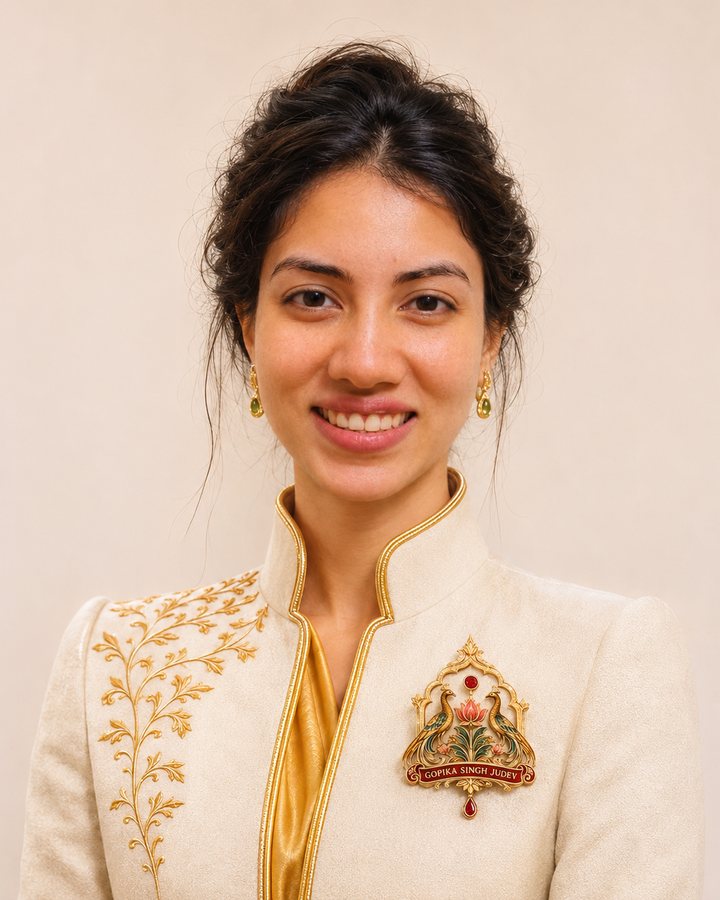
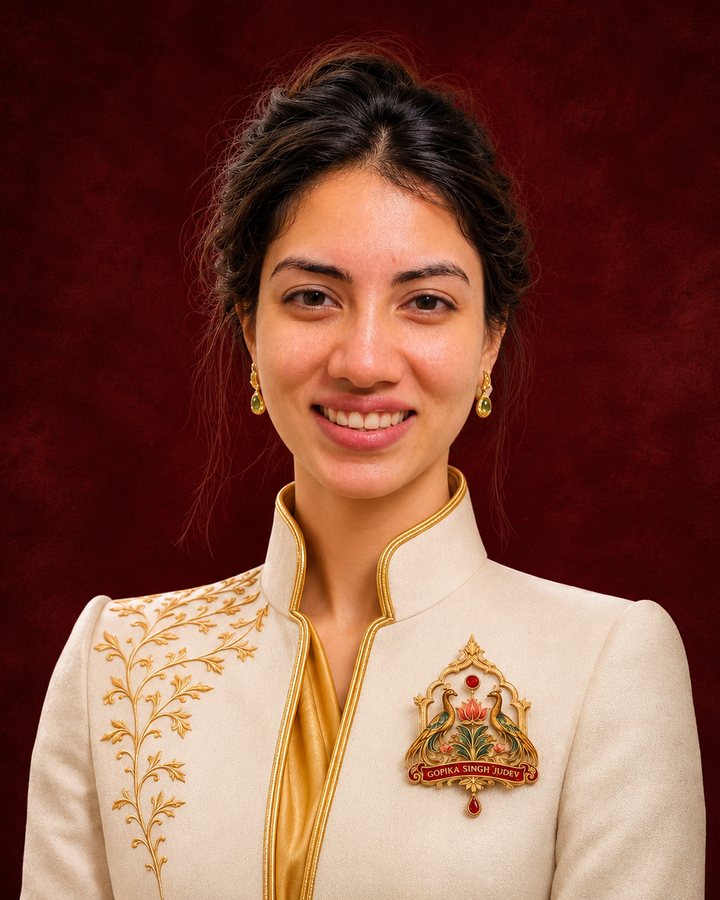
Gopika Singh Judev
Daughter Of Orchha
Historian, listener and the founder of Aadivamsha and Demi Princess.
Who Is The Founder Of Aadivamsha?
Gopika Singh Judev is a Daughter of Orchha and the founder of Aadivamsha and of Demi Princess, its public voice, which is devoted to the voices, customs and quieter histories of India’s royal families.
Her foundations were laid at one of India’s most distinguished schools, where she rose to lead the student body. A historian by training, she was later honoured for academic excellence at her convocation. History gave her a lasting interest in how institutions and traditions outlive the worlds that made them and in what changes when a society built on hierarchy meets a modern republic. It also left her with an interest in how public policy shapes the lives of ordinary people.
Her working life has been spent in education and language. As a language consultant she advised students preparing for study and careers abroad, helping them find precision and confidence in how they speak and write. That work shaped the way she listens: patiently, closely and with an ear for what is left unsaid.
Through Aadivamsha and Demi Princess she brings these strands together. She hosts Crown Unscripted, a conversation series in which royal families speak among their own and curates The Noblesse, where they write in their own words. Her approach is composed and exact, with an understated elegance that makes even the most private stories feel safe in her hands.
The Heritage She Carries
Orchha, On The Betwa
What Was Orchha?
A kingdom of Central India and the senior state of the Bundelas, in the uplands between the Yamuna and the Narmada.
Orchha is said to mean the hidden place and the name suits it.
In 1531 Rudra Pratap Singh of the Bundelas chose a rocky island where the Betwa divides, deep in the forests of Bundelkhand and raised a capital there. Palaces rose on the island and temples on the bank. The cenotaphs of the kings were set along the water, where they still stand. For two and a half centuries this was the seat of the foremost of the Bundela states.
The Bundelas gave their name to the whole of Bundelkhand, the upland country of granite ridges, rivers and tanks that lies between the Yamuna and the Narmada. Orchha was first among their states and its rulers were long counted the first of the princes of Bundelkhand.
Its builders worked in a manner of their own, where the Rajput palace and the Mughal pavilion meet. The Jahangir Mahal, raised by Raja Bir Singh Deo for the emperor’s visit, climbs in tiers of domes and screens around a great court. The Chaturbhuj temple lifts its spires higher than any palace beside it. In the Raja Mahal and the Lakshmi Narayan temple the walls carry painted stories from the Ramayana and the Bhagavata, still bright after four hundred years.
The court was a home of letters too. Keshavdas, one of the great poets of early Hindi, wrote at Orchha and his works on the art of poetry and on the story of Rama are read to this day.
Where A King Gave His Throne To A God
Tradition holds that Queen Ganesh Kunwari, wife of Raja Madhukar Shah, brought an image of Rama from Ayodhya to Orchha and that once it was set down in her palace it would not be moved. The palace became the Ram Raja Temple.
There Rama is worshipped not only as a deity but as the reigning king and he receives a guard of honour each day. The rulers of Orchha held their kingdom in his name. To be raised in that tradition is to learn early that what one holds is held for another.
In 1783 the court moved to Tikamgarh and Orchha was left to the river, the forest and the temple. The state kept a salute of fifteen guns under the Crown. After independence it joined the Indian Union, becoming part of Vindhya Pradesh and later of Madhya Pradesh. The kingdom passed into history. The inheritance did not. Orchha’s palaces and temples are now on UNESCO’s tentative list of World Heritage and pilgrims still come each day to the king who is a god.
Her Vision
The Task She Has Set Herself
To follow the inheritance of this land from its origins to the present day and to see that it is understood, kept in use and handed on.
She does not see that task as the work of one family, or of royal families alone. It asks for historians and archaeologists, for architects, cooks, weavers and musicians, for the families who kept things and the people who made them. Her part is to bring them to the same table and to earn the trust that lets them speak freely.
Nor does she see it as work for one form. Some of it will be told in conversation and in writing. Some will be filmed, recorded, mapped and exhibited. Some will be made by hand. She intends to use the instruments of this age, from three-dimensional mapping to archives that can be searched in many languages, so that what is gathered now can be found by anyone, anywhere, a century on.
A Note From The Founder
I was raised to understand that what a family inherits is held in trust. None of it was ever ours alone. It came from those before us and it is owed to those who come after.
Much of it was never written down. It lives in kitchens and workshops, in songs and in the hands of people whose families have served the same houses for generations. When those voices fall quiet, a line breaks and no one notices.
Aadivamsha exists so that it does not. We will sit with those who study and those who remember, ask what is known and what is carried and take both forward with care.
I hope you will join us at the table.